MULTITUDE OF BLOGS None of the PDFs are my own productions. I've collected them from web (e-mule, avax, libreremo, socialist bros, cross-x, gigapedia..) What I did was thematizing. This blog's project is to create an e-library for a Heideggerian philosophy and Bourdieuan sociology Φ market-created inequalities must be overthrown in order to close knowledge gap. this is an uprising, do ya punk?
Showing posts with label science. Show all posts

Wednesday, February 20, 2008

Descartes Embodied: Reading Cartesian Philosophy through Cartesian Science


Descartes Embodied: Reading Cartesian Philosophy through Cartesian Science
by Daniel Garber

# Hardcover: 352 pages
# Publisher: Cambridge University Press (December 18, 2000)

Review
"This volume is valuable in that it collects in one place essays otherwise not too easy to come by and which together offer a compelling interpretation of Descartes's thought by one of its most distinguished contemporary readers." Review of Metaphysics

"The quality of scholarship and intelligence of the author make for an excellent and highly recommended book for upper-division undergraduates through faculty and advanced scholars." Choice

Book Description
This volume collects some of the seminal essays on Descartes by Daniel Garber, one of the preeminent scholars of early-modern philosophy. A central theme unifying the volume is the interconnection between Descartes's philosophical and scientific interests, and the extent to which these two sides of the Cartesian program illuminate each other, a question rarely treated in the existing literature. This collection will be a mandatory purchase for any serious student of or professional working in 17th-century philosophy, history of science, or history of ideas.

go

Sunday, February 17, 2008

Gadamer - Reason in the Age of Science


Reason in the Age of Science
(Studies in Contemporary German Social Thought)
by Hans-George Gadamer

# Paperback: 216 pages
# Publisher: The MIT Press (September 14, 1983)

"This book will consolidate Gadamer's growing reputation in the English-speaking world. It will serve as an ideal introduction to Gadamer's thought, and to problems of hermeneutics more generally, since the essays included are clear and easy to follow. For those already familiar with Gadamer's philosophy, these essays are equally important because they illustrate themes in the recent development of his ideas. No one who reads this book will any longer suppose that hermeneutics is indifferent to social critique or political practice. I know of no other short work by Gadamer that offers a more succinct yet brilliant demonstration of the contemporary importance of Gadamer's philosophy."
- Anthony Giddens, Kings College, Cambridge

"This collection of probing and lucidly written essays shows Gadamer as the leading Continental philosopher after Heidegger. It is an impassioned defense of practical reason, and of hermeneutics as a mode of practical philosophy, against the twin dangers of scientism and ideological partisanship. In the best humanist tradition Gadamer vindicates philosophical reflection as basic precondition of a life 'worth living.'"
- Fred R. Dallmayr, University of Notre Dame

after reading two reviews above you should be downloading this one! [photo taken at 1993]

How Images Think by Ron Burnett


How Images Think
by Ron Burnett


# Paperback: 275 pages
# Publisher: The MIT Press; New Ed edition (April 1, 2005)

Review
"I tried to think of a witty play on 'Every picture tells a thousand words,' but then the whole word/picture thing collapsed on me. Burnett really marries the two together. This book is actually billions of pictures in disguise. Required reading in these accelerating times."
--Douglas Coupland, novelist and visual artist

"This is a brilliant book that makes a much-needed contribution to new media research and cultural theory, written with great clarity and visionary purpose."
--Janine Marchessault, Associate Professor of Film Studies, York University

"How Images Think maps afresh the territory of how we engage with new media. Burnett challenges us to rethink our interpretation of the changing mediascape in which images are used as the main form of interaction and communication. It is crucial reading for those interested in understanding the relationships we have with the images that surround us."
--Ilana Snyder, Associate Professor, Faculty of Education, Monash University

"This insightful investigation of how digital--and other--images modify, if not rule, the way we think is urgent reading for those among us who spend more than half their lives glued to one screen or another (TV, computer, PDA, cellphone, etc). That is, most of us."
--Derrick de Kerckhove, Director, McLuhan Program in Culture & Technology, University of Toronto

Book Description
Digital images are an integral part of all media, including television, film, photography, animation, video games, data visualization, and the Internet. In the digital world, spectators become navigators wending their way through a variety of interactive experiences, and images become spaces of visualization with more and more intelligence programmed into the very fabric of communication processes. In How Images Think, Ron Burnett explores this new ecology, which has transformed the relationships humans have with the image-based technologies they have created. So much intelligence has been programmed into these image-dependent technologies that it often seems as if images are "thinking"; ascribing thought to machines redefines our relationship with them and enlarges our ideas about body and mind. Burnett argues that the development of this new, closely interdependent relationship marks a turning point in our understanding of the connections between humans and machines.

After presenting an overview of visual perception, Burnett examines the interactive modes of new technologies -- including computer games, virtual reality, digital photography, and film -- and locates digital images in a historical context. He argues that virtual images occupy a "middle space," combining the virtual and the real into an environment of visualization that blurs the distinctions between subject and object -- part of a continuum of experiences generated by creative choices by viewers, the results of which cannot be attributed either to images or to participants.

busy doing nothing

Friday, November 2, 2007

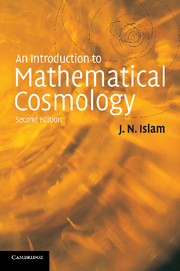
An Introduction To Mathematical Cosmology


An Introduction to Mathematical Cosmology
2nd Edition
J. N. Islam
University of Chittagong, Bangladesh

This book provides a concise introduction to the mathematical aspects of the origin, structure and evolution of the universe. The book begins with a brief overview of observational and theoretical cosmology, along with a short introduction of general relativity. It then goes on to discuss Friedmann models, the Hubble constant and deceleration parameter, singularities, the early universe, inflation, quantum cosmology and the distant future of the universe. This new edition contains a rigorous derivation of the Robertson-Walker metric. It also discusses the limits to the parameter space through various theoretical and observational constraints, and presents a new inflationary solution for a sixth degree potential. This book is suitable as a textbook for advanced undergraduates and beginning graduate students. It will also be of interest to cosmologists, astrophysicists, applied mathematicians and mathematical physicists.
Contents

Preface to first edition; Preface to second edition; 1. Some basic concepts and an overview of cosmology; 2. Introduction to general relativity; 3. The Robertson-Walker metric; 4. The Friedmann models; 5. The Hubble constant and the deceleration parameter; 6. Models with a cosmological constant; 7. Singularities in cosmology; 8. The early universe; 9. The very early universe and inflation; 10. Quantum cosmology; 11. The distant future of the universe; Appendix.

bu soyadla tc ye cumhur olsun

Thursday, September 20, 2007

Science and Social Science: An Introduction


Science and Social Science: An Introduction

Is social science really a science at all, and if so in what sense? This is the first real question that any course on the philosophy of the social sciences must tackle. In this brief introduction, Malcolm Williams gives the students the grounding that will enable them to discuss the issues involved with confidence


ahanda

The Tyranny of Health - Doctors and the Regulation of Lifestyle


The Tyranny of Health - Doctors and the Regulation of Lifestyle


Review
'The Tyranny of Health expresses with great clarity and precision the growing sense of unease that many people, both inside and outside of the medical profession, are begining to experience.' - Social Issues Research Centre
'This is an heretical book. The scared cows of health promotion are dispatched with greater zeal than that with which the British beef herd was slaughtered at the height of the BSE crisis.' - Dr David Wainwright, International Epidemiology
'A thrilling account of the problems encountered by doctors in present-day medical practice and is highly recommended to be read also by nurses.' - Nursing Ethics 2003, 10 (3) Book Description
A topical and controversial contribution to public, professional and academic discussion of issues of health and health care. The author concludes that we need to establish a clear boundary between the worlds of medicine and politics, so that doctors can concentrate on treating the sick - and leave the well alone.