MULTITUDE OF BLOGS None of the PDFs are my own productions. I've collected them from web (e-mule, avax, libreremo, socialist bros, cross-x, gigapedia..) What I did was thematizing. This blog's project is to create an e-library for a Heideggerian philosophy and Bourdieuan sociology Φ market-created inequalities must be overthrown in order to close knowledge gap. this is an uprising, do ya punk?
Showing posts with label historiography. Show all posts

Thursday, September 20, 2007

How Historians Map the Past


The Landscape of History: How Historians Map the Past
by John Lewis Gaddis

What is history and why should we study it? Is there such a thing as historical truth? Is history a science? One of the most accomplished historians at work today, John Lewis Gaddis, answers these and other questions in this short, witty, and humane book. The Landscape of History provides a searching look at the historian's craft, as well as a strong argument for why a historical consciousness should matter to us today. Gaddis points out that while the historical method is more sophisticated than most historians realize, it doesn't require unintelligible prose to explain. Like cartographers mapping landscapes, historians represent what they can never replicate. In doing so, they combine the techniques of artists, geologists, paleontologists, and evolutionary biologists. Their approaches parallel, in intriguing ways, the new sciences of chaos, complexity, and criticality. They don't much resemble what happens in the social sciences, where the pursuit of independent variables functioning with static systems seems increasingly divorced from the world as we know it. So who's really being scientific and who isn't? This question too is one Gaddis explores, in ways that are certain to spark interdisciplinary controversy. Written in the tradition of Marc Bloch and E.H. Carr, The Landscape of History is at once an engaging introduction to the historical method for beginners, a powerful reaffirmation of it for practitioners, a startling challenge to social scientists, and an effective skewering of post-modernist claims that we can't know anything at all about the past. It will be essential reading for anyone who reads, writes, teaches, or cares about history.

paylaştıkça artan tat

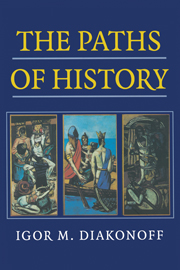
The Paths Of History


The Paths Of History


Cambridge University Press:
This is a broad and ambitious study of the entire history of humanity that takes as its point of departure Marx's theory of social evolution. Professor Diakonoff's theory of world history differs from Marx's in a number of ways. First, he has expanded Marx's five stages of development to eight. Second, he denies that social evolution necessarily implies progress and shows how "each progress is simultaneously a regress," and third, he demonstrates that the transition from one stage to another is not necessarily marked by social conflict and that sometimes this is achieved peacefully and gracefully. As the book moves through these various stages, the reader is drawn into a remarkable and thought-provoking study of the process of the history of the human race that focuses on the wide range of factors (economic, social, military-technological, and socio-pyschological) that have influenced our development from palaeolithic times to the present day.

Contents
Foreword Geoffrey Hosking; Author’s preface; Introduction; 1. First phase (primitive); 2. Second phase (primitive communal); 3. Third phase (early antiquity); 4. Fourth phase (imperial antiquity); 5. Fifth phase (the Middle Ages); 6. The sixth phase (the stable absolutist post-medieval phase); 7. Seventh phase (capitalist); 8. Eighth phase (post-capitalist).


An Introduction to the Practices of History


Making History: An Introduction to the Practices of History


Book DescriptionMaking History is a comprehensive exploration of the practice of history, historical tradition and the theories which surround it. Encompassing a huge diversity of influences, the book is organised around the following themes: * Crises and Transformations: An assessment of the most significant movements in historical scholarship in the last century, including the Annales and Bielefeld Schools, and the development of social and economic history * Theories into History: An investigation into the penetration of theory into historical practice, examining the social movements and ideologies which propelled the change, including Marxism, post-modernism and gender history * Moving beyond History: An enquiry into the increasingly interdisciplinary trends in scholarship, revealing the interconnections between history, archaeology, psychoanalysis, sociology, anthropology, and literature; scholars from non-historical disciplines have contributed to provide a unique approach to a controversial debate * Beyond the Academy: An exploration of the changes in historical practice with reference to film, amateur history, heritage, popular culture, and New Labour.


Approaching the Ancient World


Literary Texts and the Greek Historian (Approaching the Ancient World)


Book DescriptionLiterary Texts and the Greek Historian provides a comprehensive and well-documented survey of the ways in which non-historical texts, as well as historical ones, can be used to construct Greek history. Christopher Pelling introduces the volume with a chapter on the inventiveness of ancient authors and explores the genres of literature from which we construct our accounts of ancient history. --This text refers to the Library Binding edition. SynopsisOur knowledge of Greek history rests largely on literary texts - not merely historians (especially Herodotus, Thucylides and Xenephon), but also tragedies, comedies, speeches, biographies and philosophical works. These texts are themselves among the most skilled and highly wrought productions of a brilliant rhetorical culture. How is the historian to use them? This book addresses this problem by taking a series of extended test-cases, and discussing how we should and should not try to exploit the texts. In some instances we can investigate 'what really happened', and the ways in which the texts manipulate, remould, or colour it according to their own rhetorical strategies; in others the most illuminating aspect may be those strategies themselves, and what they tell us about the culture - how it figured questions of sex and gender, politics, citizenship and the city, the law and the courts and how wars happen. Literary Texts and the Greek Historian concentrates on Athens in the second half of the fifth-century, when many of the principal genres came together, but includes some examples from earlier (Aeschylus Oresteia and later (including Aristotles poetics ). Literary Texts and the Greek Historian examines the range of responses to these texts and suggests new ways in which literary criticism can illuminate the society from which these texts sprang.