MULTITUDE OF BLOGS None of the PDFs are my own productions. I've collected them from web (e-mule, avax, libreremo, socialist bros, cross-x, gigapedia..) What I did was thematizing. This blog's project is to create an e-library for a Heideggerian philosophy and Bourdieuan sociology Φ market-created inequalities must be overthrown in order to close knowledge gap. this is an uprising, do ya punk?
Showing posts with label civilization. Show all posts

Wednesday, February 6, 2008

Braudel - Afterthoughts on Material Civilization and Capitalism


Afterthoughts on Material Civilization and Capitalism
(The Johns Hopkins Symposia in Comparative History)
by Fernand Braudel

"In this concise book... Braudel summarizes the broad themes of his three-volume Civilisation materielle et capitalisme, 1400-1800 and offers his reflections on the historian's craft and on the nature of the historical imagination... Taken as a whole, the book is provocative and stimulating. On occasion, it rises to revelation when two or three sentences of compressed but brilliant prose force us to reconsider the events of an entire century or the history of a continent." -- American Historical Review.

more than history

Sunday, October 14, 2007

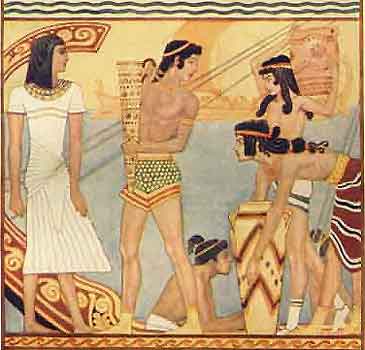
Minoans: Life in Bronze Age Crete


Minoans: Life in Bronze Age Crete
Rodney Castleden
Routledge

In this companion to The Knossos Labyrinth (Routledge, 1990), Castleden gives us an outline of the Minoan culture that, he alleges, is more consistent with recent archaeological evidence: that Knossos was a temple, not a palace, in which occurred not only athletic games and graceful rites, but also human sacrifice and other behaviors pointing to a previously unsuspected dark side to the Minoan personality; and that the Minoan world view and distinctive artistic vision were stimulated by the widespread eating of opium. His revision is not implausible. In early cultures the line between church and state tended to be hazy; so with its architecture. On the other hand, in his zeal to reexamine all traditional theories Castleden frequently proposes scenarios drawn more from psychosocial inference than evidence, yielding arguments less compelling than the originals. A nation of addicts could scarcely have had the energy to execute drug-induced creativity, much less to develop the commercial empire that was ancient Crete under the Minoans. Thought-provoking nonetheless.
-Jo-Ann D. Suleiman, Sanad Support Technologies, Rockville, Md.

minoalılar sizi büyükşehir yapacam

Thursday, September 20, 2007

Approaching the Ancient World


Literary Texts and the Greek Historian (Approaching the Ancient World)


Book DescriptionLiterary Texts and the Greek Historian provides a comprehensive and well-documented survey of the ways in which non-historical texts, as well as historical ones, can be used to construct Greek history. Christopher Pelling introduces the volume with a chapter on the inventiveness of ancient authors and explores the genres of literature from which we construct our accounts of ancient history. --This text refers to the Library Binding edition. SynopsisOur knowledge of Greek history rests largely on literary texts - not merely historians (especially Herodotus, Thucylides and Xenephon), but also tragedies, comedies, speeches, biographies and philosophical works. These texts are themselves among the most skilled and highly wrought productions of a brilliant rhetorical culture. How is the historian to use them? This book addresses this problem by taking a series of extended test-cases, and discussing how we should and should not try to exploit the texts. In some instances we can investigate 'what really happened', and the ways in which the texts manipulate, remould, or colour it according to their own rhetorical strategies; in others the most illuminating aspect may be those strategies themselves, and what they tell us about the culture - how it figured questions of sex and gender, politics, citizenship and the city, the law and the courts and how wars happen. Literary Texts and the Greek Historian concentrates on Athens in the second half of the fifth-century, when many of the principal genres came together, but includes some examples from earlier (Aeschylus Oresteia and later (including Aristotles poetics ). Literary Texts and the Greek Historian examines the range of responses to these texts and suggests new ways in which literary criticism can illuminate the society from which these texts sprang.