MULTITUDE OF BLOGS None of the PDFs are my own productions. I've collected them from web (e-mule, avax, libreremo, socialist bros, cross-x, gigapedia..) What I did was thematizing. This blog's project is to create an e-library for a Heideggerian philosophy and Bourdieuan sociology Φ market-created inequalities must be overthrown in order to close knowledge gap. this is an uprising, do ya punk?
Showing posts with label history. Show all posts

Monday, February 11, 2008

The Arabs in History by Bernard Lewis


The Arabs in History
by Bernard Lewis

Paperback: 256 pages
Publisher: Oxford University Press, USA; 6New Ed edition (May 23, 2002)

`Whoever lives in our country, speaks our language, is brought up in our culture and takes pride in our glory is one of us.' Thus ran a declaration of modern leaders of Arab states. But what exactly is an Arab, and what has been their place in the course of human history? In this well-established classic, Professor Lewis examines the key issues of Arab development - their identity, the national revival which cemented the creation of the Islamic state, and the social and economic pressures that destroyed the Arab kingdom and created the Islamic empire. He analyses the forces which contributed to that empire's eventual decline, and the effects of growing Western influence. Today, with the Arab world facing profound social and political challenges, it constitutes an essential introduction to the Arabs and their history

selam ya ihvan!

Friday, December 14, 2007

Heidegger Reexamined - H. Dreyfus (ed.)


Heidegger Reexamined
by Hubert L. Dreyfus (Editor), Mark Wrathall (Editor)
thank you Routledge

1408 pages

This collection of facsimile reprints brings together the most important recent scholarship examining the major stages in Heidegger's philosophical career. The first volume focuses on Heidegger's major work, Being and Time , as well as Heidegger's essays and lecture courses produced during the genesis of Being and Time, and shortly after its publication. The second volume covers the period from shortly after the publication of Being and Time up to the Letter on Humanism - that is, the period of Heidegger's notorious 'turn'. Volume three addresses the 'late' Heidegger: his thought from the 1940s until his death in 1976. It focuses on language and poetry, his renewed encounter with pre-Socratic philosophy, his development of the doctrine of the fourfold of earth, sky, mortals, and divinities, and his repeated attempts to radicalize his earlier accounts of Being and unconcealment. The fourth and final volume focuses on Heidegger's significance for contemporary issues in philosophy. Articles in this volume explore Heidegger's relevance to particular areas such as philosophy of mind and language, and relate Heidegger's thought to the philosophy of other contemporary philosophers like Wittgenstein, Searle, Davidson, Rorty, Levinas and Derrida.

to begin with being with-in
Fearless yet, if he must, man stands, and lonely vol 1
Before God, simplicity protects him, vol 2
No weapon does he need nor subterfuge vol 3
Until God's being "not there" helps him. vol 4
Hölderlin

Sunday, December 2, 2007

The Ottoman Empire and the World Around it - Suraiya Faroqhi


The Ottoman Empire and the World Around it - Suraiya Faroqhi
I.B Tauris

In Islamic law the world was made up of the House of Islam and the House of War with the Ottoman Sultan--the perceived successor to the Caliphs--supreme ruler of the Islamic world. However, Suraiya Faroqhi demonstrates that there was no iron curtain between the Ottoman and other worlds but rather a long-established network of diplomatic, financial, cultural and religious connections. These extended to the empires of Asia and the modern states of Europe. Faroqhi's book is based on a huge study of original and early modern sources, including diplomatic records, travel and geographical writing, as well as personal accounts.

once upon a time is now

Friday, November 2, 2007

History of Mathematics: from Mesopotamia to Modernity


A History of Mathematics:
From Mesopotamia to Modernity
by Luke Hodgkin
Reviewed by Herbert Kasube

The first thing you notice about this text is its thickness, or should I say lack of thickness. For a text that claims to go "From Mesopotamia to Modernity" it is remarkably thin, just 281 pages, and that includes the bibliography and index. Do not let its thin size deceive you. There is still a substantial amount of material here. The first 132 pages cover Babylonian and Geek mathematics in sufficient depth to give the reader a good feel for the mathematics done by these two ancient civilizations. The coverage is probably not as thorough as that found in other texts, but the topics are well chosen. There is also a chapter on Chinese mathematics and another on Islamic mathematics. While I would hesitate to call these chapters "sparse", it is fair to say that they are "to the point".

To understand the direction that this text is taking one must read the "Introduction" carefully. Hodgkin spends thirteen pages justifying the text and his approach to the history of mathematics. His philosophy is (essentially) that other textbooks in the history of mathematics are "accumulation(s) of facts". He bases his approach on a quote from E. H. Carr who wrote

What had gone wrong was the belief in this untiring and unending accumulation of facts as the foundation of history, the belief that facts speak for themselves and that we cannot have too many facts, a belief at that time so unquestioning that few historians then thought it necessary — and some still think it unnecessary today — to ask themselves the question 'What is history?' (E. H. Carr, in What is History?)

Hodgkin's goal was to write a history of mathematics book that answers Carr's fundamental question. Much time is spent on historiography and not just history. That can be a bit of a double-edged sword. I found the philosophical discussion of history in the Introduction very interesting, but at the same time it was a bit distracting, especially some of his "political" commentary. For example, in discussing a letter written by Simone Weil on the teaching of the history of science Hodgkin made a point of mentioning her "extreme-left sympathies" which had little to do with the context. Part of me wanted to say, "Let's get on with the history of mathematics!"

Once I got past the Introduction I found the exposition to be quite readable and the coverage adequate. I must say "adequate" and not "complete" because the author admits to leaving out some topics typically found in a textbook on this subject. He omits "Egypt, the Indian contribution aside from Kerala and most of the European eighteenth and nineteenth centuries." His bibliography is relatively extensive and does include what he would call "more traditional" textbooks in which the deleted material could be found.

The chapter on the calculus presents a balanced view of both Newton and Leibniz with an excellent use of diagrams. There is also a concise discussion of the "priority dispute" between Newton and Leibniz.

Exercises are sprinkled throughout the text with many having solutions appearing at the end of the chapter. The selection is adequate, but as with other aspects of this book, a bit sparse.

In conclusion, Hodgkin makes the case in his Introduction for a different perspective on the history of mathematics. His argument is well justified and I think he succeeds in producing a text that is different from others on the market. That is the good news. The bad news is that it may not be to the liking of instructors looking for a textbook that would be successful in the classroom. Practitioners of the history of mathematics will find the approach taken by Hodgkin to be interesting and insightful. It is a much tougher read for individuals new to the subject.

kitabı okuduktan sonra olayı aştım: 2+2=5

Sunday, October 14, 2007

The Longest War: Northern Ireland's Troubled History


The Longest War: Northern Ireland's Troubled History
Marc Mulholland
Oxford

'The Troubles' in Northern Ireland have proved one of the most intractable conflicts in Europe since the Second World War, consistently attracting international attention, particularly from the United States. This highly readable exploration of the central issues and debates about Northern Ireland sets them in the historical context of hundreds of years of conflict. It tackles many questions, such as: What accounts for the perpetuation of ethnic and religious conflict in Ireland? Why has armed violence proven so hard to control? Who are the major figures and issues in the conflict? Can we expect more 'Northern Irelands' in the future?

`The Longest War, a masterly feat of compression . . . is excellent on the paradoxes of political developments since the ceasefires.' Financial Times 26/01/01

`a useful little handbook with some easy-to-access basic information' Irish Democrat April/May 2002

`a brief and helpful introduction to the Troubles. . . . The Volume's great value is that offers a lucidly and lightly written, short introduction to a subject that will continue to haunt many people for a very' TLS 29/03/02

viva IRA

[bende bazen neden tüm terörist gruplara sempatim var diye sormuyor değilim]

Minoans: Life in Bronze Age Crete


Minoans: Life in Bronze Age Crete
Rodney Castleden
Routledge

In this companion to The Knossos Labyrinth (Routledge, 1990), Castleden gives us an outline of the Minoan culture that, he alleges, is more consistent with recent archaeological evidence: that Knossos was a temple, not a palace, in which occurred not only athletic games and graceful rites, but also human sacrifice and other behaviors pointing to a previously unsuspected dark side to the Minoan personality; and that the Minoan world view and distinctive artistic vision were stimulated by the widespread eating of opium. His revision is not implausible. In early cultures the line between church and state tended to be hazy; so with its architecture. On the other hand, in his zeal to reexamine all traditional theories Castleden frequently proposes scenarios drawn more from psychosocial inference than evidence, yielding arguments less compelling than the originals. A nation of addicts could scarcely have had the energy to execute drug-induced creativity, much less to develop the commercial empire that was ancient Crete under the Minoans. Thought-provoking nonetheless.
-Jo-Ann D. Suleiman, Sanad Support Technologies, Rockville, Md.

minoalılar sizi büyükşehir yapacam

Friday, September 28, 2007

Six Days Of War: June 1967 And The Making Of The Modern Middle East


Six Days Of War:
June 1967 And The Making Of The Modern Middle East

This is the most complete history to date of the Six Day War of 1967, in which Israel entered and began its occupation of the West Bank and Gaza Strip. While no account can be definitive until Arab archives open, Oren, a Princeton-trained senior fellow at Jerusalem's Shalem Center who has served as director of Israel's department of inter-religious affairs and as an adviser to Israel's U.N. delegation, utilizes newly available archival sources and a spectrum of interviews with participants, including many Arabs, to fill gaps and correct misconceptions. Further, Six Days of War is an attack on "post-Zionism": the school of politics and history that casts Israel as the author of policies that intentionally promote the destuction of Palestine as a separate entity and of Palestinians as a people, not least through the occupation that began with the 1967 War. By contrast, Oren convincingly establishes in an often engrossing narrative the reactive, contingent nature of Israeli policy during both the crisis preceding the conflict and the war itself. As Prime Minister Levi Eshkol held the Israeli Defense Forces in check that May, Operation Dawn, an Egyptian plan for a preemptive strike against Israel, came within hours of implementation. It was canceled only because Egypt's President Gamal Abdel Nasser feared it had been compromised. Israel's decision to seek its own security in arms was finally triggered, Oren shows, by Jordan's late accession to the hostile coalition dominated by Egypt and Syria. Geographically, the West Bank, then under Jordanian rule and occupation, cut Israel nearly in half. The military risk to Israel was unacceptable, Oren makes clear, in the context of a U.S. enmeshed in Vietnam and a West unwilling to act even in support of the status quo. Far from being a product of strategic calculation, Oren further argues, occupation of the West Bank and the Gaza Strip was also contingent: the consequence of a victory so rapid and one-sided that even Israel's generals found it difficult to believe it was happening. Israel, having proved it could not be defeated militarily and now possessing something to trade, hoped for comprehensive peace negotiations in a rational-actor model. Oren notes that some initiatives for peace did in fact develop. He seems, however, trying to convince himself along with his readers. Oren puts what he sees as Israel's enduring weaknesses in relief: not arrogance, but self-doubt, self-analysis and self-criticism, all carried to near-suicidal degrees in 1967. Arab policy, by contrast, featured a confident commitment to erasing Israel from the map. The Six Day War shook that confidence, he finds, but did not alter the commitment. About the nature of Israeli policy since the war, the book says little, but finds that "for all its military conquests, Israel was still incapable of imposing the peace it craved.

bir'ruh bid'dem nefruke ya HAMAS! [return of the repressed in its most violent form is in a state of becoming: bir sabah anne bir sabah süpürmek için açtığında kapını nice yaşıtlarım ellerinde çiçekler, çiçekler içinde bir ülke getirirler]

Le Goff - The Birth of Europe


The Birth of Europe (Making of Europe) - Jacques Le Goff

In this ground-breaking book, the great French historian Jacques Le Goff tells the story of the key events and ideas that shaped the Middle Ages. His overview ranges widely, from the Fall of Rome to the Discovery of the Americas, and from Ireland to the Black Sea.In clear, concise language, the author presents his personal view of the importance of the Middle Ages and its lasting legacy to Europe. He contends that it was in the Middle Ages that many of the institutions and beliefs we consider to be "European " were defined and developed for the first time: ideas about a common Christian society, public spaces, courtship, and marriage.The Birth of Europe presents the historical facts and events that shaped the period, but also the formation of attitudes and concepts of a European "dream ". The Middle Ages manifested the combination of diversity and unity present in Europe today: the mixing of populations, West-East and North-South oppositions, but above all the unifying role of culture.The book is an ideal introduction to the medieval world for students, as well as anyone interested in how "Europe " was born.

run forest run!

Thursday, September 20, 2007

How Historians Map the Past


The Landscape of History: How Historians Map the Past
by John Lewis Gaddis

What is history and why should we study it? Is there such a thing as historical truth? Is history a science? One of the most accomplished historians at work today, John Lewis Gaddis, answers these and other questions in this short, witty, and humane book. The Landscape of History provides a searching look at the historian's craft, as well as a strong argument for why a historical consciousness should matter to us today. Gaddis points out that while the historical method is more sophisticated than most historians realize, it doesn't require unintelligible prose to explain. Like cartographers mapping landscapes, historians represent what they can never replicate. In doing so, they combine the techniques of artists, geologists, paleontologists, and evolutionary biologists. Their approaches parallel, in intriguing ways, the new sciences of chaos, complexity, and criticality. They don't much resemble what happens in the social sciences, where the pursuit of independent variables functioning with static systems seems increasingly divorced from the world as we know it. So who's really being scientific and who isn't? This question too is one Gaddis explores, in ways that are certain to spark interdisciplinary controversy. Written in the tradition of Marc Bloch and E.H. Carr, The Landscape of History is at once an engaging introduction to the historical method for beginners, a powerful reaffirmation of it for practitioners, a startling challenge to social scientists, and an effective skewering of post-modernist claims that we can't know anything at all about the past. It will be essential reading for anyone who reads, writes, teaches, or cares about history.

paylaştıkça artan tat

Rewriting the Self - History, Memory and Narrative

[Cy Twombly's "Venus"]

Rewriting the Self - History, Memory and Narrative

THE CREATIVE PROCESS OF NARRATING THE SELF
Professor Freeman's teaching and research interests include history and philosophy of psychology, the psychology of the self, and the psychology of art and creativity. His first book, Rewriting the Self: History, Memory, Narrative (Routledge, 1993), inquires into the process by which people reconstruct the meaning and significance of past experience. In order to answer the question, who am I?, a person turns to the past and, from the vantage point of the present, seeks to make sense of the movement of her/his life. The self created in the process of narrating is thus to be regarded not as some substantial "thing" but rather as a series of continuous tellings and re-tellings, issuing from the work of the narrative imagination. A second book, Finding the Muse: A Sociopsychological Inquiry into the Conditions of Artistic Creativity (Cambridge, 1993), explores the lives of a group of aspiring American artists, focusing especially on problems of creativity as they relate to such issues as the mystique of the modern artist, the fashioning of artistic identity, and the limits and possibilities of modern art itself.


http://www.snapdrive.net/files/494742/kutu1/Rewriting%20the%20Self%20-%20History%2C%20Memory%20and%20Narrative%20%281996%29.pdf

Companion to the History of Economic Thought


Companion to the History of Economic Thought (2003).


Assembling contributions from top thinkers in the field, this Companion offers a comprehensive and sophisticated exploration of the history of economic thought. The volume has a threefold focus: the history of economic thought, the history of economics as a discipline, and the historiography of economic thought. The essays in the first part focus on the history of economic ideas, with topics ranging from ancient, medieval, and Islamic thought, to Marxian, Utopian, and postwar thought. The second part explores important historiographical topics, including the sociology of economics, methodology, exegesis, and textuality.Each essay serves as a complex introduction to the chosen topic, and gathered together they provide an extensive synthesis of the field as a whole. The volume is an essential resource for anyone researching or studying the history of economic thought, and will also serve as an excellent text for courses in this area


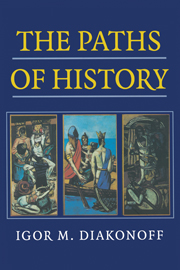
The Paths Of History


The Paths Of History


Cambridge University Press:
This is a broad and ambitious study of the entire history of humanity that takes as its point of departure Marx's theory of social evolution. Professor Diakonoff's theory of world history differs from Marx's in a number of ways. First, he has expanded Marx's five stages of development to eight. Second, he denies that social evolution necessarily implies progress and shows how "each progress is simultaneously a regress," and third, he demonstrates that the transition from one stage to another is not necessarily marked by social conflict and that sometimes this is achieved peacefully and gracefully. As the book moves through these various stages, the reader is drawn into a remarkable and thought-provoking study of the process of the history of the human race that focuses on the wide range of factors (economic, social, military-technological, and socio-pyschological) that have influenced our development from palaeolithic times to the present day.

Contents
Foreword Geoffrey Hosking; Author’s preface; Introduction; 1. First phase (primitive); 2. Second phase (primitive communal); 3. Third phase (early antiquity); 4. Fourth phase (imperial antiquity); 5. Fifth phase (the Middle Ages); 6. The sixth phase (the stable absolutist post-medieval phase); 7. Seventh phase (capitalist); 8. Eighth phase (post-capitalist).


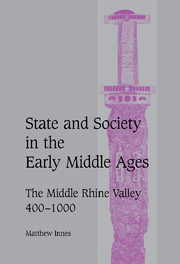
State And Society in The Early Middle Ages

State and Society in the Early Middle Ages:
The Middle Rhine Valley, 400-1000

(Cambridge Studies in Medieval Life and Thought: Fourth Series)

Synopsis:
This book is a pioneering study of politics and society in the early Middle Ages. Whereas it is widely believed that the source materials for early medieval Europe are too sparse to allow sustained study of the workings of social and political relationships on the ground, this book focuses on a uniquely well-documented area to investigate the basis of power. Topics covered include the foundation of monasteries, their relationship with the laity, and their role as social centres; the significance of urbanism; the control of land, the development of property rights and the organization of states; community, kinship and lordship; justice and dispute settlement; the uses of the written word; violence and the feud; and the development of political structures from the Roman empire to the high Middle Ages.


An Introduction to the Practices of History


Making History: An Introduction to the Practices of History


Book DescriptionMaking History is a comprehensive exploration of the practice of history, historical tradition and the theories which surround it. Encompassing a huge diversity of influences, the book is organised around the following themes: * Crises and Transformations: An assessment of the most significant movements in historical scholarship in the last century, including the Annales and Bielefeld Schools, and the development of social and economic history * Theories into History: An investigation into the penetration of theory into historical practice, examining the social movements and ideologies which propelled the change, including Marxism, post-modernism and gender history * Moving beyond History: An enquiry into the increasingly interdisciplinary trends in scholarship, revealing the interconnections between history, archaeology, psychoanalysis, sociology, anthropology, and literature; scholars from non-historical disciplines have contributed to provide a unique approach to a controversial debate * Beyond the Academy: An exploration of the changes in historical practice with reference to film, amateur history, heritage, popular culture, and New Labour.


Approaching the Ancient World


Literary Texts and the Greek Historian (Approaching the Ancient World)


Book DescriptionLiterary Texts and the Greek Historian provides a comprehensive and well-documented survey of the ways in which non-historical texts, as well as historical ones, can be used to construct Greek history. Christopher Pelling introduces the volume with a chapter on the inventiveness of ancient authors and explores the genres of literature from which we construct our accounts of ancient history. --This text refers to the Library Binding edition. SynopsisOur knowledge of Greek history rests largely on literary texts - not merely historians (especially Herodotus, Thucylides and Xenephon), but also tragedies, comedies, speeches, biographies and philosophical works. These texts are themselves among the most skilled and highly wrought productions of a brilliant rhetorical culture. How is the historian to use them? This book addresses this problem by taking a series of extended test-cases, and discussing how we should and should not try to exploit the texts. In some instances we can investigate 'what really happened', and the ways in which the texts manipulate, remould, or colour it according to their own rhetorical strategies; in others the most illuminating aspect may be those strategies themselves, and what they tell us about the culture - how it figured questions of sex and gender, politics, citizenship and the city, the law and the courts and how wars happen. Literary Texts and the Greek Historian concentrates on Athens in the second half of the fifth-century, when many of the principal genres came together, but includes some examples from earlier (Aeschylus Oresteia and later (including Aristotles poetics ). Literary Texts and the Greek Historian examines the range of responses to these texts and suggests new ways in which literary criticism can illuminate the society from which these texts sprang.